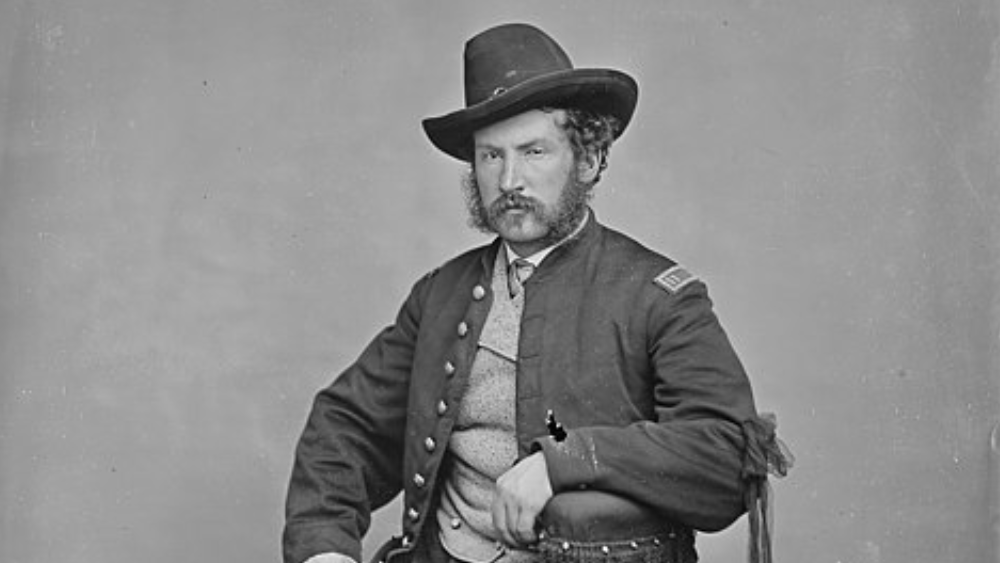
History often remembers the moment when a crime is committed, but far less attention is given to the men who carry the heavy responsibility of restoring justice. One such figure is Captain Edward P. Doherty, a Civil War officer whose name is forever tied to one of the most dramatic manhunts in American history—the pursuit and capture of John Wilkes Booth, the assassin of President Abraham Lincoln.
Doherty was not seeking fame. Like many soldiers of his time, he was driven by duty, discipline, and loyalty to his country. Yet his actions in April 1865 placed him at the center of a national reckoning during one of the darkest moments in American history.
A Soldier Shaped by a Divided Nation
Born in 1840, Edward P. Doherty came of age as the United States drifted toward civil war. When conflict finally erupted in 1861, young men across the nation were forced to choose where they stood. Doherty chose the Union, enlisting in the 16th New York Cavalry, a regiment known for its mobility, discipline, and critical role in intelligence and pursuit operations.
As a cavalry officer, Doherty learned quickly that war was not only fought on open battlefields. It was also waged through long rides, strategic thinking, and relentless determination. These skills would later define his most important mission.
The Nation in Mourning
On April 14, 1865, President Abraham Lincoln was shot at Ford’s Theatre in Washington, D.C. The president died the following morning, plunging the nation into shock and grief just days after the Civil War had effectively ended.
John Wilkes Booth, a well-known actor and Confederate sympathizer, fled the capital almost immediately. His escape triggered one of the largest manhunts in American history. The government demanded swift justice—not only to punish the assassin, but to reassure a wounded nation that order would prevail.
Captain Edward P. Doherty was soon assigned to the pursuit.
The Hunt for John Wilkes Booth
Booth’s escape route took him through southern Maryland and into Virginia, aided by Confederate sympathizers and driven by desperation. The chase lasted nearly two weeks, during which Booth evaded capture while injured and increasingly unstable.
Doherty, leading a detachment of the 16th New York Cavalry, followed a trail of intelligence reports, interrogations, and local tips. The hunt required patience, sharp judgment, and unwavering resolve. Booth was armed, dangerous, and willing to die rather than be taken alive.
By April 26, 1865, Doherty’s unit tracked Booth to the Garrett farm near Port Royal, Virginia. Booth and his companion, David Herold, were hiding in a tobacco barn on the property.
The Final Confrontation
Surrounding the barn under the cover of darkness, Doherty and his men demanded surrender. Herold quickly gave himself up, but Booth refused. He shouted defiance, pacing inside the barn and declaring he would not be taken alive.
After a tense standoff, Doherty made the critical decision to order the barn set on fire to force Booth out. The flames illuminated Booth’s silhouette inside, revealing a man cornered by his own actions.
Moments later, Booth was shot and fatally wounded. Though controversy would later surround the exact circumstances of the shot, the mission’s outcome was clear: Lincoln’s assassin was captured and neutralized. The manhunt was over.
Duty Over Glory
Despite the national importance of the mission, Captain Doherty did not seek recognition. In fact, much of the credit was distributed among various officers and units involved in the pursuit. Doherty returned to military life as a man who had completed his duty at a critical moment in history.
The aftermath of Lincoln’s assassination was politically charged, emotionally raw, and heavily scrutinized. Doherty remained largely silent, letting his actions speak for themselves. He had fulfilled his orders, upheld military discipline, and played a decisive role in restoring a sense of justice to a grieving nation.
Life After the War
Following the Civil War, Edward P. Doherty lived out his remaining years away from the national spotlight. Like many veterans, he carried the weight of his wartime experiences quietly. The manhunt for Booth was only one chapter in a life shaped by service, sacrifice, and the burden of history.
Doherty passed away in 1897, at the age of 57. While he never became a household name, his legacy endures as part of one of the most pivotal moments in American history.
Remembering Captain Doherty
Today, Captain Edward P. Doherty rests in Section 1, Grave 690, among other veterans who answered their country’s call. His grave serves as a quiet reminder that history is not shaped solely by presidents and generals, but by determined individuals willing to act when the moment demands it.
Doherty’s story is not one of ambition or notoriety. It is the story of a soldier who stood firm in the face of national tragedy and helped bring closure to a nation struggling to heal. His role in capturing John Wilkes Booth was not just about ending a manhunt—it was about reaffirming justice, order, and accountability at a time when the country desperately needed all three.
A Legacy of Resolve
In remembering Captain Edward P. Doherty, we remember the power of resolve in moments of crisis. His actions remind us that even in the chaos following unimaginable loss, there are individuals who rise—not for recognition, but because it is their duty.
More than a century later, his name may not be widely known, but his contribution remains deeply woven into the fabric of American history. Captain Doherty was not merely a witness to history—he helped shape its course.