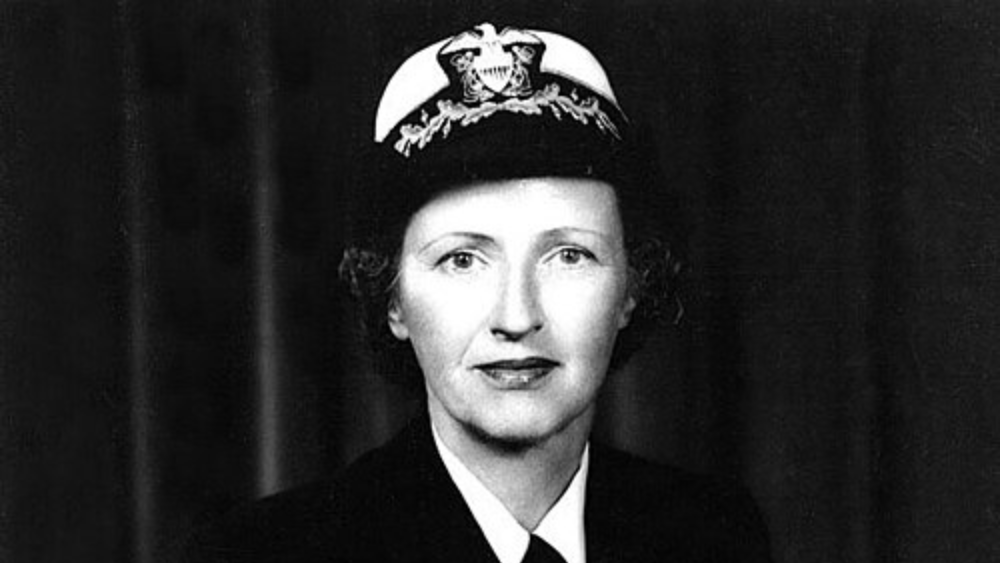
Joy Bright Hancock’s life reads like a story of quiet determination, personal loss, and historic impact. Born at the turn of the 20th century, she lived through two world wars, helped transform the role of women in the United States Navy, and rose through the ranks at a pace few—male or female—could match. Her legacy is not only one of service but of resilience, leadership, and lasting change.
Early Life and the Call to Serve
Joy Bright was born on May 4, 1898, in Wildwood, New Jersey, a coastal town whose proximity to the sea may have subtly shaped her future. After attending business school in Philadelphia, she entered adulthood during a time when women’s roles were narrowly defined. World War I, however, changed everything.
When the United States entered the war, Joy answered the call to serve by enlisting in the Navy as a Yeoman (F), one of the first official avenues for women to serve in uniform. She worked at Camden, New Jersey, and later at Naval Air Station Wildwood. Though administrative in title, her work placed her at the heart of a rapidly modernizing Navy, one increasingly shaped by aviation and global conflict.
Love, Loss, and an Unbreakable Resolve
After World War I, Joy married Lieutenant Charles Gray Little. Their marriage ended tragically when Little died in 1921 in the crash of the British-built airship ZR-2, marking the first of several personal tragedies tied to naval aviation.
Rather than retreat from the world that had taken so much from her, Joy leaned further into it. In 1922, she joined the Navy’s Bureau of Aeronautics, where she took on editorial responsibilities for the Bureau’s News Letter—work that would later evolve into Naval Aviation News. Her role positioned her at the intersection of communication, aviation, and military leadership, a time when all three fields were rapidly evolving.
In 1924, Joy remarried, this time to Lieutenant Commander Lewis Hancock Jr. Once again, tragedy struck. In September 1925, Hancock lost his life when the airship USS Shenandoah (ZR-1) crashed during a storm. Twice widowed by the dangers of early military aviation, Joy faced grief that could have ended her public career. Instead, it strengthened her sense of purpose.
A Pioneer in Naval Public Affairs
After further study at the Foreign Service School and earning a private pilot’s license—an achievement rare for women at the time—Joy returned to the Bureau of Aeronautics. For more than a decade, leading up to World War II and into the early months of the conflict, she was responsible for the Bureau’s public affairs activities.
In this role, she became a bridge between the Navy and the public, shaping how naval aviation was understood and supported. Her work required clarity, diplomacy, and strategic thinking—skills that would soon prove essential on a much larger scale.
World War II and the Rise of the WAVES
On October 15, 1942, Joy Bright Hancock was commissioned as a lieutenant in the newly formed Women Accepted for Volunteer Emergency Service, known as the WAVES. The program represented a bold experiment: integrating women into critical naval roles during wartime.
Joy quickly became one of its most influential leaders. She served as the WAVES representative within the Bureau of Aeronautics. There, she advocated for the effective integration of women into naval operations. Later, she took on the same role for the Deputy Chief of Naval Operations (Air). This position allowed her to expand her influence at the highest levels of naval leadership. Her abilities did not go unnoticed, and she was promoted to lieutenant commander in November 1943. By the end of the war, she had advanced to the rank of commander, a clear testament to her competence and the confidence placed in her leadership.
At the conclusion of World War II, she received a Letter of Commendation from the Secretary of the Navy. The citation praised her leadership, judgment, and pivotal role in integrating women into naval service. Her recommendations on living standards and working conditions directly improved efficiency and morale for women serving in both the United States and Hawaii.

Architect of Women’s Permanent Place in the Navy
In February 1946, Commander Hancock took on the role of Assistant Director (Plans) of the Women’s Reserve and, just months later, stepped into the position of Director. By July 1946, she was leading the WAVES during one of the most uncertain periods in Navy history—the transition from wartime expansion to peacetime contraction.
In October 1948, the Navy promoted her to captain just six years after her commission. This achievement marked one of the fastest ascents to that rank in U.S. Navy history.
As Director of the Women’s Reserve, Captain Joy Bright Hancock played a central role in a major change in naval history: integrating women into the Regular Navy. She later served as Assistant Chief of Naval Personnel for Women, continuing her groundbreaking work. Her leadership guided the creation of policies for recruitment, training, housing, administration, and welfare. These efforts laid the foundation for generations of women who would follow in her footsteps.
Recognition and Lasting Impact
Captain Hancock retired from active duty in June 1953. Upon her retirement, she received the Legion of Merit in recognition of her exceptionally meritorious conduct. The citation highlighted her extraordinary organizational ability and her success in overcoming complex challenges during the formative years of women’s permanent inclusion in the Navy.
In 1954, she married Vice Admiral Ralph A. Ofstie and accompanied him during his tour as Commander of the Sixth Fleet. After he died in 1956, Joy lived quietly between Washington, D.C., and the Virgin Islands, reflecting a life that had already reshaped history.
A Legacy Remembered
In 1972, Joy Bright Hancock published her autobiography, Lady in the Navy: A Personal Reminiscence. The book allowed her to tell her own story after a lifetime defined more by service than by the spotlight.
She died on August 20, 1986, at age 88, and the nation honored her lifelong service by laying her to rest at Arlington National Cemetery beside Admiral Ofstie.
Her legacy continues to grow. On December 16, 2024, the U.S. Navy announced that a future Constellation-class frigate, FFG-69, will bear her name. It is a powerful tribute to a woman who not only served in the Navy but helped redefine it.
Honors and Awards
Captain Joy Bright Hancock’s service was recognized with numerous decorations, including the Legion of Merit, Navy Commendation Medal, World War I Victory Medal, American Campaign Medal, World War II Victory Medal, and the National Defense Service Medal.
Her story is not simply one of rank or recognition. It is the story of perseverance through loss, leadership in times of uncertainty, and a lifelong commitment to service. Joy Bright Hancock did more than make history—she made it possible.