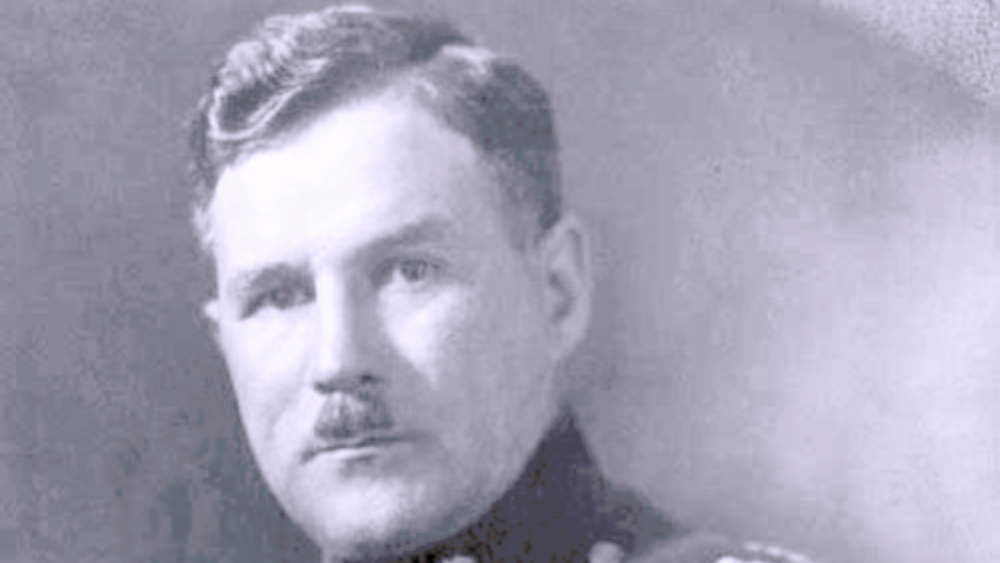
Maj. Louis Cukela’s life reads like a powerful American story—one shaped by courage, sacrifice, and an unwavering belief in duty. Born far from U.S. shores, Cukela would go on to earn one of the nation’s highest military honors not once, but twice. His journey from a small village in Croatia to the battlefields of World War I stands as a testament to how determination and valor can shape history, regardless of where one begins.
A Humble Beginning Far from Home
Louis Cukela was born on May 27, 1888, in Split, Croatia, then part of the Austro-Hungarian Empire. Like many young men of his generation, he grew up amid political uncertainty and limited opportunity. Life was hard, and prospects were narrow. Yet Cukela possessed a strong sense of ambition and resilience—qualities that would define his future.
In 1913, at the age of 25, Cukela made the life-altering decision to leave his homeland and immigrate to the United States. He arrived with little more than hope and a willingness to work. America, at the time, was a land of opportunity for immigrants willing to contribute, and Cukela quickly embraced his new country with deep gratitude and loyalty.
Choosing Service as a New American
Only a year after arriving in the United States, Cukela enlisted in the U.S. Army in 1914. His decision to serve so quickly reflected not obligation, but commitment. Though not yet a citizen, he believed in defending the nation that had given him a new start.
When the United States entered World War I in 1917, Cukela transferred to the U.S. Marine Corps—a move that would define his legacy. Known for their rigorous standards and intense combat roles, the Marines demanded physical endurance, mental toughness, and courage under fire. Cukela possessed all three.
World War I and the Battlefields of France
World War I was unlike any conflict the world had seen before. Trench warfare, machine guns, poison gas, and relentless artillery fire created conditions of unimaginable danger. It was in this brutal environment that Louis Cukela would distinguish himself as one of the most heroic figures of the war.
Serving in France with the Marine Corps, then-Sergeant Cukela demonstrated extraordinary bravery during combat operations against heavily fortified German positions. On April 14, 1918, near the village of Villers-Cotterêts, Cukela single-handedly assaulted enemy machine-gun nests that were pinning down Allied forces.
Armed only with a rifle and a bayonet, Cukela advanced alone across open ground under intense fire. He eliminated enemy positions, captured prisoners, and returned critical intelligence that allowed his unit to advance. His actions saved lives and turned the tide in a dangerous engagement.
A Rare and Unmatched Honor
For his extraordinary heroism, Louis Cukela was awarded the Medal of Honor—twice. He received both the Army Medal of Honor and the Navy Medal of Honor for the same acts of valor, a distinction that would later become prohibited under military policy.
Today, only 19 individuals in U.S. history have received the Medal of Honor more than once, and Cukela remains one of the few to have earned the nation’s highest award from two separate branches of service. This rare recognition reflects not just bravery, but heroism of the highest order.
Beyond the Medals of Honor, Cukela also received numerous other decorations, including the Distinguished Service Cross and foreign awards from Allied nations who recognized his gallantry on the battlefield.
Rising Through the Ranks
After the war, Louis Cukela continued his military career, transitioning from enlisted ranks to commissioned officer—a notable achievement, especially for an immigrant who began his service as a private. He rose to the rank of Major in the U.S. Marine Corps, serving with distinction during the interwar years and into World War II.
Cukela was not only respected for his combat experience but also admired for his leadership and discipline. He embodied the values of the Marine Corps: honor, courage, and commitment. Fellow Marines regarded him as a role model, someone who led by example rather than words alone.

Life Beyond the Battlefield
Despite his decorated military career, Cukela lived a relatively quiet life outside of service. He never sought fame or public attention for his heroism. Instead, he remained humble, deeply loyal to the Marine Corps, and grateful to the country that had embraced him.
His story resonates not because he sought recognition, but because he earned it through selfless action. Cukela represented the countless immigrants who helped build and defend the United States—individuals who believed in the nation’s ideals and were willing to sacrifice everything to protect them.
A Final Resting Place of Honor
Maj. Louis Cukela passed away on March 19, 1956. In recognition of his extraordinary service and sacrifice, he was laid to rest at Arlington National Cemetery, one of the nation’s most hallowed grounds. His grave is located in Section 1, Grave 427-A, among other heroes who shaped American history.
Visitors who pause at his resting place may not immediately recognize his name, but his legacy speaks volumes. Beneath the headstone lies a man who crossed oceans, fought fearlessly, and proved that courage knows no borders.
A Legacy That Endures
Louis Cukela’s life reminds us that heroism often comes from unexpected places. He was an immigrant who became a Marine, a private who became a major, and a soldier who earned America’s highest honor twice through sheer bravery.
His story is not just about war—it is about identity, loyalty, and the power of choice. In choosing to serve a new homeland, Cukela demonstrated the deepest form of patriotism: action.
More than a century later, Maj. Louis Cukela stands as a symbol of courage and devotion, reminding us that greatness is defined not by where we come from but by what we are willing to stand for.