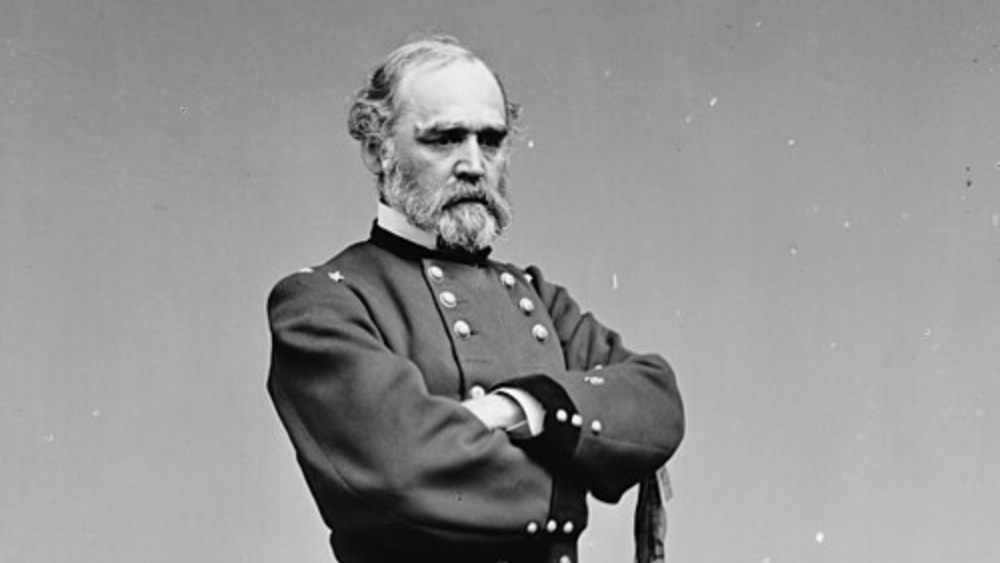
Major General Montgomery Cunningham Meigs was not a battlefield commander whose name thundered through history with the roar of cannons. Instead, his legacy is quieter, deeper, and perhaps more enduring. As the Quartermaster General of the U.S. Army during the Civil War, Meigs became the architect of logistics, infrastructure, and remembrance—most notably through his role in establishing Arlington National Cemetery, a place that continues to define how a nation honors its fallen.
Born on May 3, 1816, in Augusta, Georgia, Montgomery Meigs came of age in a young country still defining itself. From an early age, he displayed an exceptional aptitude for mathematics and engineering, talents that would shape the course of his life and, ultimately, American history. He entered the United States Military Academy at West Point and graduated in 1836, launching a career that would tie engineering precision to moral conviction.
An Engineer at the Heart of the Capital
Before the war ever reached American soil, Meigs had already left his mark on Washington, D.C. As an officer in the U.S. Army Corps of Engineers, he supervised several of the nation’s most important prewar infrastructure projects. Among them was the Washington Aqueduct, a vital system designed to provide clean water to the capital—an achievement that improved public health and supported the city’s growth.
Even more symbolically, Meigs oversaw major phases of construction on the U.S. Capitol itself, including the wings and the iconic dome. At a time when the nation was expanding and wrestling with its identity, Meigs helped shape the very buildings that represented democracy and unity. Ironically, the dome he helped construct would later stand as a symbol of continuity during the Civil War, rising over a divided nation.
Loyalty in a Time of Division
When the Civil War erupted in 1861, loyalties across the country were tested. Meigs, a Southerner by birth, made his allegiance unmistakably clear: he stood firmly with the Union. This decision came at great personal cost. His former commanding officer, Robert E. Lee, resigned from the U.S. Army to lead Confederate forces—an act Meigs regarded as betrayal.
In May 1861, shortly after the war began, Meigs was appointed Quartermaster General of the U.S. Army, a role that would place him at the logistical center of the Union war effort. It was a staggering responsibility. The Union Army expanded rapidly, and supplying hundreds of thousands of soldiers with food, uniforms, weapons, transportation, medical supplies, and shelter required an unprecedented level of organization.
Meigs proved equal to the challenge. Tireless, demanding, and deeply principled, he revolutionized military logistics. He modernized supply systems, cracked down on corruption, and insisted on accountability. Many historians credit Meigs as one of the unsung heroes of Union victory, arguing that without his efficiency and discipline, the army could not have sustained itself through years of brutal conflict.
Creating a Sacred Ground
As casualties mounted, another challenge emerged—how to care for the dead. Soldiers were dying in numbers the nation had never known, and existing burial grounds were insufficient. Meigs, overseeing military burials, confronted the grim reality of war not just in numbers, but in human loss.
In May 1864, Meigs decided that it would echo far beyond the war itself. He designated part of the former estate of Robert E. Lee and his wife, Mary Custis Lee, as a military cemetery. The land, overlooking Washington, D.C., was already occupied by Union troops. Meigs intentionally placed graves close to the Lee mansion, ensuring the property could never again serve as a private residence.
This decision was practical, symbolic, and deeply personal. Arlington National Cemetery was born not merely as a burial ground, but as a statement—that the Union would remember its dead, and that sacrifice would be honored on hallowed ground.
A Life Marked by Duty and Loss
Despite his professional accomplishments, Meigs’s life was not untouched by personal tragedy. He lost several of his children, including sons who died during the Civil War. These losses shaped his understanding of sacrifice, giving him a deeply human connection to the thousands of families who mourned fallen soldiers.
His wife, Louisa Meigs, was his lifelong companion and source of stability. When she died in 1879, she became the first person buried in the Meigs family plot at Arlington National Cemetery, located off what is now Meigs Drive. Her burial tied Meigs’s personal life forever to the sacred ground he had helped establish.
After retiring from active service in 1882, Meigs remained respected as a figure of integrity, discipline, and public service. He spent his final years reflecting on a life defined by duty rather than glory.
Final Honors at Arlington
Major General Montgomery Meigs died on January 2, 1892. In death, as in life, he was honored by the institution he had served so faithfully. He received full military honors and was laid to rest beside his wife at Arlington National Cemetery—Section 1, Grave 1-EH.
There is something profoundly fitting about Meigs’s final resting place. He did not merely work at Arlington; he shaped its purpose, its permanence, and its meaning. Every row of white headstones, every quiet ceremony, and every moment of reflection owes something to his vision.
A Legacy Beyond Stone and Marble
Montgomery Meigs’s legacy is not defined by monuments bearing his name, but by systems that worked, structures that endured, and values that lasted. He believed that a nation must care for those who serve it—both in life and in death. Arlington National Cemetery stands as a living testament to that belief.
In a country shaped by conflict and sacrifice, Meigs helped ensure that remembrance would never be an afterthought. Through discipline, conviction, and quiet resolve, he built more than infrastructure—he built a national conscience.
And today, as visitors walk the grounds of Arlington, many unaware of his name, they are nonetheless walking through the enduring legacy of Major General Montgomery Meigs—a man who understood that honor, once earned, must never be forgotten.