
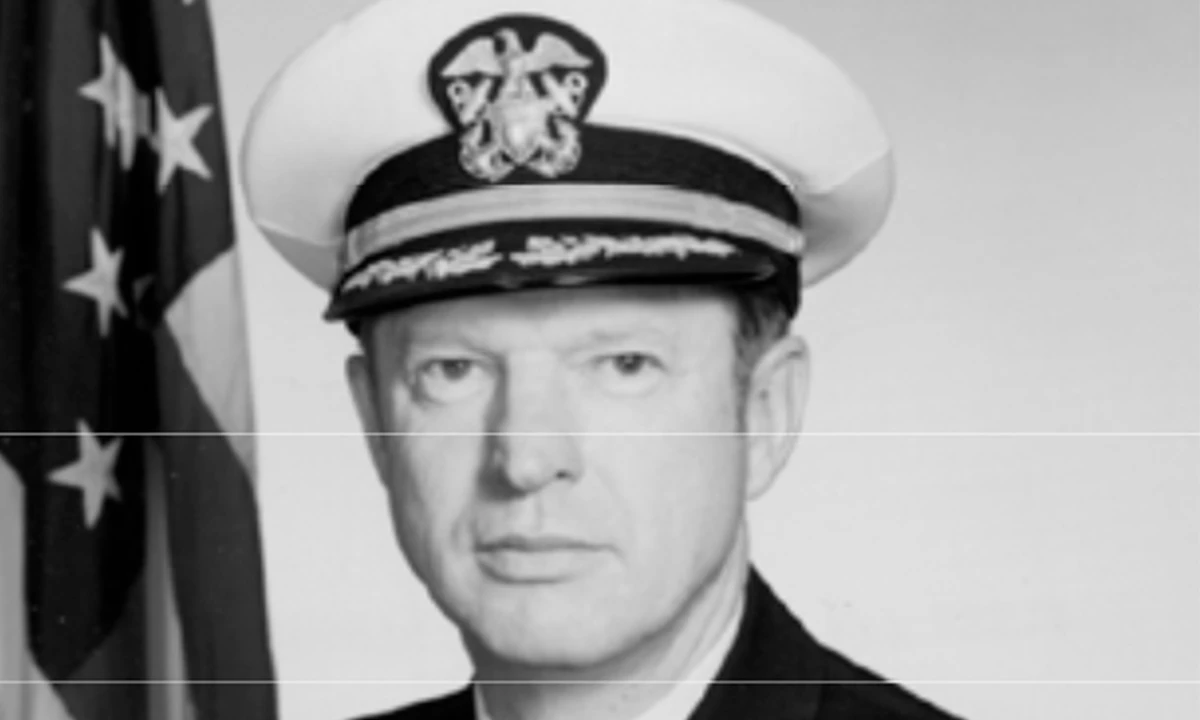
For half a century, one of the greatest feats in aviation history remained a ghost story, buried deep in classified files. Elmer Royce Williams, a retired United States Navy Captain, fought the longest dogfight in U.S. Navy history, yet he couldn’t tell a soul—not even his wife or brother.
Today, we uncover the extraordinary bravery of a naval aviator who single-handedly engaged seven Soviet fighters during the Korean War, kept a top-secret promise to the President, and finally received the nation’s highest military honors decades later.
Early Life and the Call to Duty
Royce Williams was born on April 4, 1925, and spent his formative years in Wilmot, South Dakota, and Clinton, Minnesota. The call of the skies reached both him and his brother early on, leading them to enlist during World War II with dreams of becoming pilots. Though his flight training was initially deferred so he could attend college in Minnesota, Williams officially qualified as a naval aviator at Pensacola in August 1945.
When the Korean War broke out, Williams answered the call. He learned to fly the F9F-5 Panther jet, ultimately flying 70 missions during the conflict. But it was one specific mission in 1952 that would cement his name in the annals of military aviation.
The 35-Minute Dogfight
On November 18, 1952, then-Lieutenant Williams was serving with VF-781 aboard the USS Oriskany as part of Task Force 77. During his second mission of the day, a combat air patrol near Hoeryong, North Korea, Williams and his group of four pilots spotted seven MiG-15s looming overhead.
When two of his fellow pilots had to return to the carrier, the MiGs turned their fire on Williams. What followed was a harrowing, 35-minute aerial battle. The odds were practically impossible: one American in an F9F-5 Panther against seven advanced Soviet MiG-15s.
Despite commanders on his carrier ordering him away, Williams was already fighting for his life and had to stay engaged. In a spectacular display of skill and courage, he:
- Shot down four of the enemy MiGs and likely hit two others.
- Managed to escape back to his carrier after losing his hydraulics and running completely out of ammunition.
- Landed his severely damaged aircraft safely, uninjured, despite ground crews later counting exactly 263 bullet holes in his Panther jet.
The Price of Secrecy
Word of this monumental solo victory reached the highest levels of government. Williams was debriefed by admirals, the Secretary of Defense, and newly inaugurated President Dwight D. Eisenhower.
However, the political climate of the Cold War required drastic measures. Because the Soviet Union was not officially a combatant in the Korean War, authorities feared that publicizing a direct clash with Soviet pilots would drag the Soviets deeper into the conflict.
The decision was made to scrub the dogfight from U.S. Navy and National Security Agency records. Williams was sworn to absolute secrecy. His official Navy record noted only that he had shot down one “enemy” plane and damaged another, earning him a Silver Star in 1953. True to his word as a serviceman, Williams kept the incredible true story from everyone, including his own family, until the Korean War records were finally declassified in 2002.
A Legacy Revealed and Honored
History has a way of coming to light. Following the fall of the Soviet Union in the 1990s, Soviet archives were released, confirming that of the seven MiGs Williams fought that day, only one returned to its base. A 2014 Russian book, Red Devils over the Yalu, detailed the battle and explicitly named Williams and the Soviet Naval Aviation pilots he defeated.
Williams’s military service didn’t end in Korea. He went on to fly 110 missions during the Vietnam War in A-4 Skyhawks and F-4 Phantoms from the USS Kitty Hawk. He later commanded the USS Eldorado before retiring as a Captain in 1980.
Once his 1952 heroic actions were declassified, a years-long campaign began to see him properly recognized. Justice was finally served:
- December 2022: The Navy approved upgrading his 1953 Silver Star to the Navy Cross.
- January 20, 2023: He was officially awarded the Navy Cross.
- February 24, 2026: In a monumental conclusion to his story, Williams was awarded the Medal of Honor, presented at the State of the Union Address by First Lady Melania Trump.
Captain Elmer Royce Williams’s story is a profound reminder of the silent sacrifices our veterans make. He didn’t fight for the glory or the headlines; he fought to protect his task force, and then he quietly carried the weight of history for 50 years.







Enjoy every single day
Great content! Keep up the good work!
Great post. Thanks for sharing!
Honestly, it’s really good.