Some soldiers are remembered for a single moment. Others are remembered for the standard they set—quietly, relentlessly—long after the gunfire fades. Colonel Ralph Puckett Jr. belongs in the second category.
He was an Army officer, a Ranger leader in Korea, a combat commander in Vietnam, and a lifelong builder of leaders whose influence reached well beyond any one battlefield.
What made Puckett’s story stand out wasn’t just courage under fire.
It was his refusal to accept limits—whether that meant volunteering for the hardest assignment, choosing responsibility over rank, or putting his men ahead of himself when the situation turned desperate.
Early Life: A South Georgia Foundation
Ralph Puckett Jr. was born on December 8, 1926, in Tifton, Georgia. He grew up in South Georgia, attended Tifton High School, and later finished at Baylor School (then a military academy) in Chattanooga, Tennessee. He briefly enrolled at Georgia Tech in 1943 before enlisting during World War II. That same year, he became an Eagle Scout—an early signal of the leadership and discipline that would define him.
Choosing the Hard Road: West Point and the Rangers
Puckett initially enlisted in the U.S. Army Air Corps.
Enlisted Reserve in 1943 with the goal of becoming a pilot, but when flight training opportunities collapsed due to an oversupply of pilots, he pursued another path.
In July 1945, he received an appointment to the United States Military Academy at West Point.
He graduated in 1949—captaining the Army Boxing Team—and was commissioned as an infantry second lieutenant. Deployed to Japan, he immediately volunteered for Ranger duty. When told there were no lieutenant openings in the Eighth Army Ranger Company, he reportedly offered to take a squad leader’s or rifleman’s job—positions well below his grade.
The attitude impressed the leaders forming the unit, and he was given command of the company, a billet typically held by a captain.
On October 11, 1950, the Eighth Army Ranger Company entered the Korean War.
They conducted raids in daylight and at night—exactly the kind of mission set that demanded initiative, endurance, and calm leadership under pressure.
Hill 205: “Danger Close” and a Decision Few Could Make
On November 25, 1950, Ralph Puckett Jr. and his Rangers assaulted and captured Hill 205.
This was a strategic position overlooking the Chongchon River during the Battle of the Ch’ongch’on River.
During the attack, he mounted the closest tank to better direct fire, shouted encouragement to keep the assault moving, and—when one platoon was pinned down—ran across open ground three times to draw enemy fire so his Rangers could locate and destroy the enemy positions.
That was only the beginning.
Later that night, Chinese forces began a sustained counterattack with a mortar barrage followed by wave after wave of assaults. The Rangers were heavily outnumbered—described as 10-to-1—and Puckett repeatedly called in artillery support, including “danger close” fires when the situation demanded it.
Over roughly four hours, five assaults were repulsed.
On the sixth, the position was overrun in hand-to-hand combat, and supporting fires became unreliable due to broader attacks across American lines.
Wounded multiple times—including grievous injuries after mortar rounds landed in his foxhole—Puckett ordered his Rangers to evacuate and leave him behind. Two Rangers, David Pollock and Billy Walls, ignored that order, fought off enemy soldiers near his position, and carried him out. Even after evacuation, Puckett called for artillery fire onto the hill. The cost was severe: he spent 11 months hospitalized due to the wounds from that night.
For his actions at Hill 205, Puckett originally received the Distinguished Service Cross—an award later upgraded to the Medal of Honor in 2021.
After Korea: Building Rangers and Allies
After the Korean War, Puckett continued shaping the Army’s elite. He served more than two years in the Infantry School Ranger Department as commander of the Mountain Ranger Division. As the first Ranger Advisor to the U.S. Army Mission to Colombia, he helped plan and establish the Colombian Army Escuela de Lanceros (Ranger School). Later, he commanded Special Forces “B” and “C” teams in the 10th Special Forces Group in Germany.
This part of his career matters because it shows something often overlooked: elite units don’t stay elite by accident. They stay elite because experienced leaders pass on standards, training, and culture—year after year, generation after generation.
Vietnam: Combat Leadership Under Fire—Again
In 1967, Ralph Puckett Jr. commanded the 2nd Battalion, 502nd Infantry Regiment of the 101st Airborne Division in Vietnam.
During a firefight near Đức Phổ, South Vietnam, he exposed himself to intense enemy fire and rallied an undermanned unit to defeat Viet Cong forces.
For that leadership, he was awarded a second Distinguished Service Cross.
Retirement That Didn’t Look Like Retirement
Puckett retired from active duty in 1971 after 22 years and became the national programs coordinator for Outward Bound, Inc. He later established a leadership and teamwork program called Discovery, Inc.
Eventually brought the Discovery Program to The Westminster Schools in Atlanta.
Even in civilian life, the mission stayed the same: develop people, build resilience, and teach what pressure reveals.
He remained deeply connected to the Ranger community. He was an inaugural inductee into the U.S. Army Ranger Hall of Fame in 1992 and served as the Honorary Colonel of the 75th Ranger Regiment from 1996 to 2006.
Final Years, Honors, and Legacy
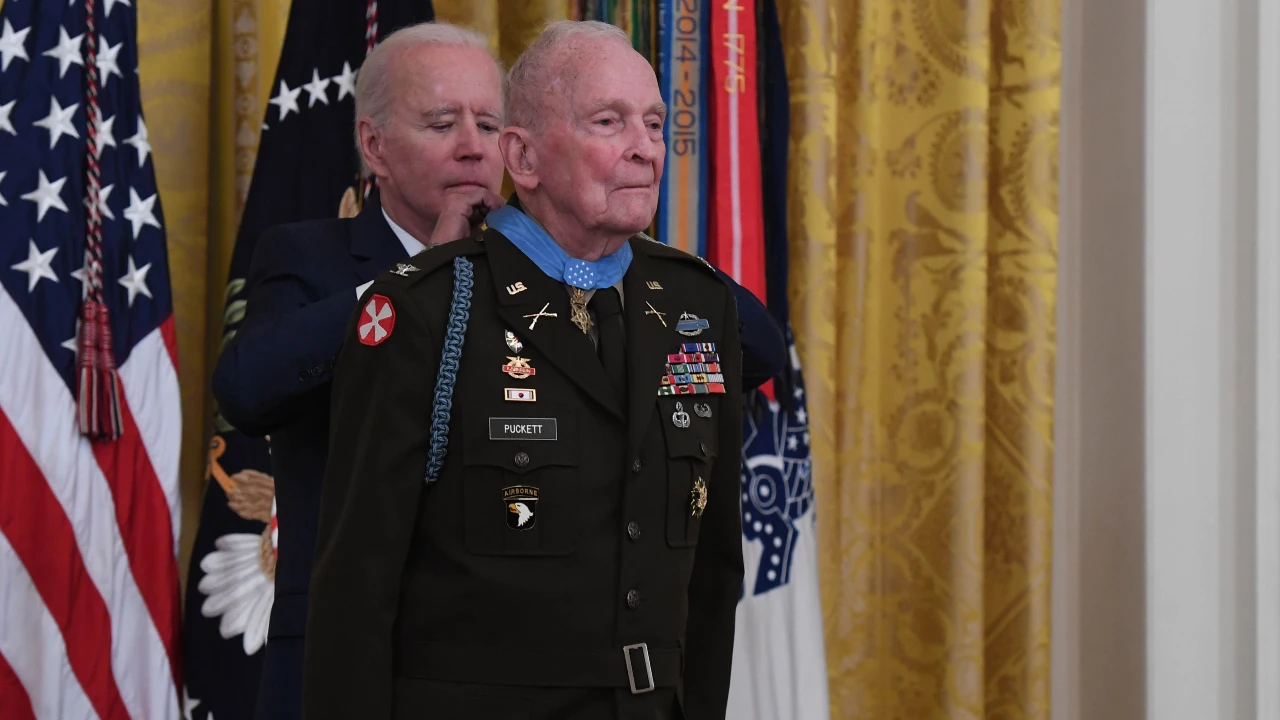
In April 2021, Puckett’s Distinguished Service Cross for Hill 205 was officially upgraded to the Medal of Honor, which he received at the White House on May 21, 2021.
Puckett died on April 8, 2024, at his home in Columbus, Georgia, at age 97.
His legacy is not confined to a citation—though the Medal of Honor citation captures the essentials:
- Leadership in the open under fire
- Refusing evacuation
- Moving from foxhole to foxhole to redistribute ammunition, and
- Ordering his men to leave him behind when he could no longer move
It lives in the Ranger Regiment’s culture, in leadership awards bearing his name, and in memorials and statues dedicated in his honor.
It includes a statue unveiled at Fort Benning in 2025 and another located at the National Infantry Museum’s Korean War Memorial.
Why Ralph Puckett Still Matters
Veterans understand something civilians often don’t: bravery isn’t a mood—it’s a decision. Ralph Puckett’s life shows what that decision looks like over decades.
He volunteered when he didn’t have to, accepted positions below his rank because the mission mattered more than ego. He led from the front when it carried the highest risk. And when the battlefield demanded the ultimate sacrifice, he tried to give it—so his Rangers could live.
That’s not just history. That’s a leadership standard.
Need support in Virginia?
Virginia Veteran and Family Support (VVFS) helps veterans and families connect with housing, financial assistance, healthcare, behavioral health services, and peer support. Learn more or request help here.