
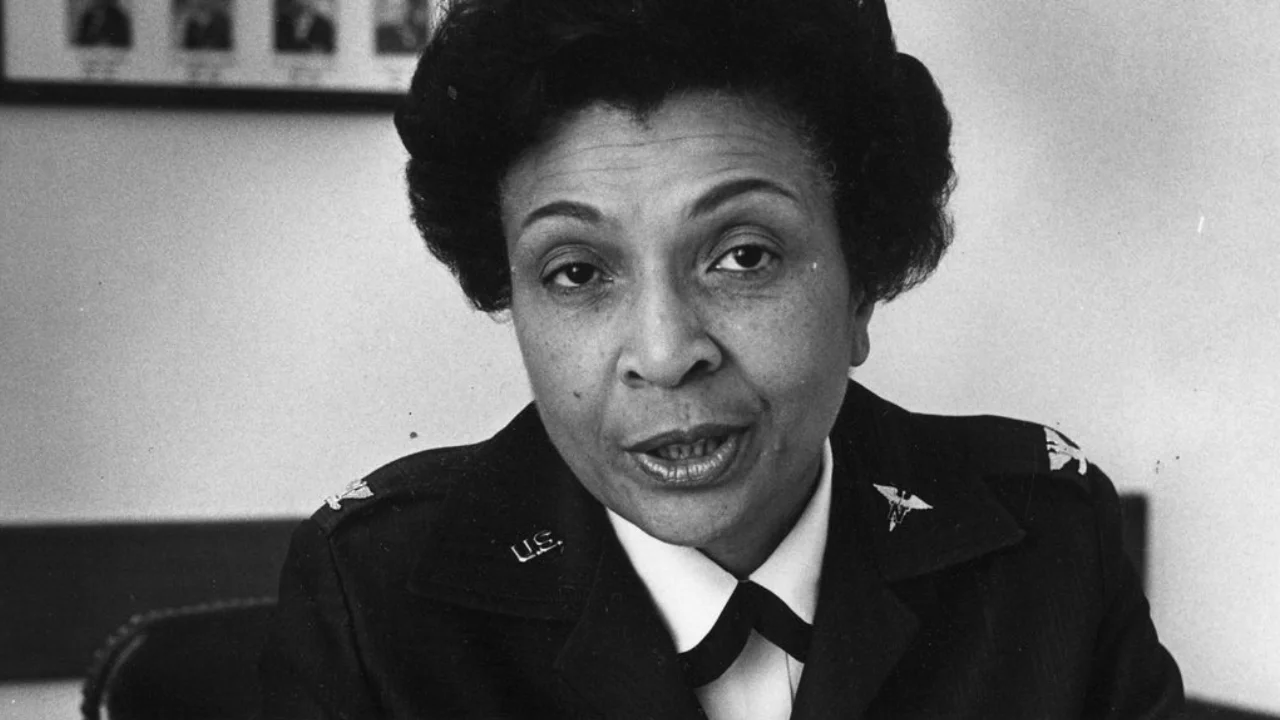
Some leaders change history with speeches. Others do it in the operating room, on hospital wards, and in the quiet decisions that keep people alive. Brigadier General Hazel Johnson-Brown was that kind of leader—an Army nurse, educator, and trailblazer whose career proved that excellence can break barriers that once seemed immovable.
In 1979, she became the first Black female general in the United States Army and the first Black chief of the U.S. Army Nurse Corps, stepping into a role that impacted thousands of nurses and countless soldiers around the world.
Early Life: A Calling That Wouldn’t Back Down
Hazel Winifred Johnson was born on October 10, 1927, in West Chester, Pennsylvania.
She was one of seven children in a farming family that earned a living through livestock and selling produce.
By age 12, she already knew she wanted to become a nurse. But the path was not open to her. She applied to the Chester County Hospital School of Nursing and was denied admission because she was Black.
So she did what resilient people often do—she found another way forward.
In 1947, she moved to New York City to attend the Harlem School of Nursing.
She started her career at Harlem Hospital in the emergency ward.
Military Career: Competence Under Pressure
Johnson-Brown enlisted in the United States Army in 1955, just seven years after the military was officially desegregated.
She rose through the ranks by doing what the military respects most: performing under pressure. According to her obituary, she impressed superiors with her skill in the operating room, taking assignments across the world, including Asia. She served in Japan and trained nurses heading to Vietnam—a reminder that service isn’t only about where you deploy, but also about the readiness you build in others.
She was also assigned to Vietnam, but illness prevented her from going. The unit that went ahead was attacked shortly after arrival, and the nurse who took her place was killed. It’s one of those heavy “what if” moments that follows many military careers—proof that fate can turn on a small detail, and that war never limits its cost to the battlefield alone.
By 1977, Ebony described her as one of the real “heavies” in her field and anticipated she could become the first Black woman general. Two years later, she did exactly that.
Becoming a General—and Leading 7,000 Nurses
When Hazel Johnson-Brown was promoted to brigadier general, she took charge of roughly 7,000 nurses in the Army Nurse Corps, becoming the first Black woman to hold that position.
During her promotion, she made it clear what mattered to her:
- “Race is an incidence of birth.”
- “I hope the criterion for selection did not include race but competence.”
That wasn’t denial of reality—it was a direct statement of standards. Her entire life had already proven what discrimination tried to erase.
Education as a Force Multiplier
Johnson-Brown didn’t stop learning, even while building a demanding Army career. She earned:
- A bachelor’s degree in nursing from Villanova University (1959)
- A master’s in teaching from Columbia University (1963)
- A doctorate in educational administration from The Catholic University of America (1978)
She also served as Director of the Walter Reed Army Institute of Nursing, helping shape the future of Army nursing through education and leadership development.
Her awards included the Army Distinguished Service Medal, Legion of Merit, Meritorious Service Medal, and Army Commendation Medal (including oak leaf cluster), and she was recognized as Army nurse of the year twice.

Post-Military Service: Still Showing Up When It Mattered
After retiring from the Army in 1983, Johnson-Brown continued leading—heading government relations for the American Nurses Association, and later serving at George Mason University where she directed the Center for Health Policy and taught as faculty.
And when the country went to war again, she didn’t stay on the sidelines. During Operation Desert Storm in 1990, she volunteered to work in the surgical suite at Fort Belvoir’s Army Hospital in Virginia.
That detail says a lot about her. Titles didn’t define her. Service did.
A “Not Quiet” Kind of Courage
One story captures her character with sharp clarity. She remembered going to a hot dog stand in Philadelphia with her mother. The waitress repeatedly served white customers first. When she finally delivered their order, Johnson-Brown refused it and told the waitress, “Now you eat it,” then told her mother, “Let’s go.”
She later said she was never a “quiet dissenter” about the slights she faced as a Black woman—inside uniform and outside it.
That’s leadership too: not just enduring injustice, but refusing to normalize it.
Personal Life, Faith, and Legacy
Hazel Johnson-Brown married David Brown in 1981 and added his name to hers; the marriage later ended in divorce and they had no children. She was Catholic and was associated with St. Clare in Clifton, Virginia, where her funeral Mass was held.
Later, she developed Alzheimer’s disease later in life and died on August 5, 2011, in Wilmington, Delaware, at age 83. She was buried at Arlington National Cemetery.
Army Nurse Corps historian Lt. Col. Nancy Cantrell remembered her as a leader who commanded during a transitional period for the Corps and led with “dignity and style,” respected and loved by those who served with her.
Why Hazel Johnson-Brown Still Matters
For veterans, her story hits home for a simple reason: she carried the mission wherever she stood—whether that meant training nurses for combat zones, building the profession through education, or volunteering decades later when the country needed experienced hands.
Hazel Johnson-Brown didn’t just break a barrier. She proved what was on the other side of it: excellence, leadership, and service that never asked to be applauded—only to be allowed to exist.
Need support in Virginia?
Virginia Veteran and Family Support (VVFS) helps veterans and families connect with housing, financial assistance, healthcare, behavioral health services, and peer support. Learn more or request help here.









This was a really informative article! Thanks for this!